
Key takeaways
- EXA Infrastructure has introduced 400-Gigabit-per-second (Gbps)-enabled services across its European, transatlantic and North American platform
- 400G brings a four-fold increase in the capacity customers can utilise through a single interface
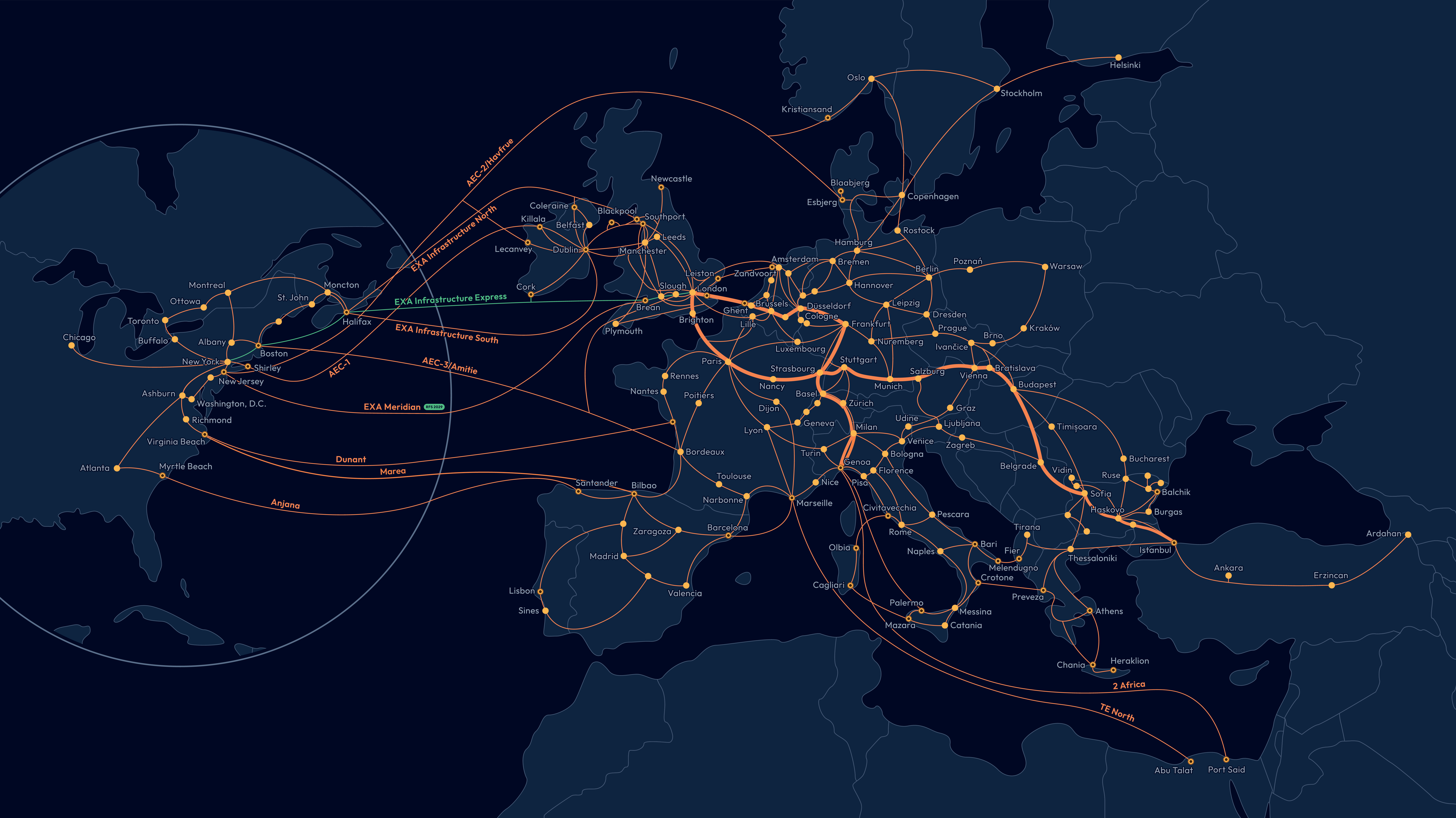
- EXA will initially enable 65,000km of its network footprint for 400G, including Express, the fastest route across the Atlantic
- 400G wavelengths are available with immediate effect, with further routes and POPs added over the coming 12 months
- Omdia expects public cloud workloads to reach 50% of all workloads by 2022, driving demand between data centres
400G services across EXA’s platform
EXA Infrastructure, the largest dedicated digital infrastructure platform connecting Europe and North America, today announced the introduction of 400-Gigabit-per-second (Gbps)-enabled services across its European, transatlantic and North American infrastructure platform, a huge step forward in optical network transport that vastly increases available capacity to customers, with reduced complexity.
What 400G wavelengths deliver
400-Gigabit (400G) wavelength services are the next frontier in optical network speeds, enabling 400 billion bits of information per second to travel down a single optical wavelength. Bringing a four-fold increase in the amount of capacity customers can utilise through a single interface, 400G simplifies bandwidth delivery with fewer patches and pluggable optics, and better energy efficiency, compared to multiple 100Gbit/s interfaces.
As hyperscale network users, large enterprises, telecoms carriers and governments look to use ever-increasing amounts of bandwidth, the jump from 100G to 400G is both a significant step forward in capacity and enables EXA to offer broader wavelength options to customers.
Comment from Steve Roberts
“400G is the next step in high-capacity bandwidth technology, and by introducing it on our network we can now look to make a substantial leap forward in the bandwidth density and service speed we offer,” said Steve Roberts, Senior Vice President Product and Marketing.
“There continues to be surging demand from our customers to carry more data, at greater speeds, and with greater efficiency, particularly for data centre-to-data centre connectivity. 400G interfaces answer this call, with a 75% reduction in patching costs and 75% fewer QSFP pluggable modules required, resulting in simplified service delivery and reduced power consumption. It is the first of many steps we intend to take to invest in further network capacity and reach,” he said.
Efficiency gains from 400G
- Four-fold increase in capacity through a single interface
- 75% reduction in patching costs
- 75% fewer QSFP pluggable modules required
- Better energy efficiency compared to multiple 100Gbit/s interfaces
Analyst view from Omdia
“EXA Infrastructure’s deployment of 400G technology across its footprint will deliver enhanced capacity for its customers, but also help address some key pain points by supporting lower hardware cost-per-bit, improved space utilisation and reduced power consumption. As Omdia’s Optical Network Strategies Survey Results – 2021 found, “for cloud providers, minimizing power consumption and quad small form-factor pluggable double-density (QSFP-DD) were key features for 400G”,” said Julian Watson, Principal Analyst, Wholesale Telecoms at Omdia. “The pandemic has accelerated the shift of workloads to the public cloud. Omdia expects the number of workloads running in the public cloud to reach 50% of all workloads by 2022, a significant jump from 30% in 2019. This trend will itself drive growing demand for increased capacity between data centres.”
Availability and rollout
EXA Infrastructure will initially enable 65,000km of its network footprint to support 400G, including Express, the fastest route across the Atlantic, which equates to more than 3000 possible route combinations. 400G wavelengths are available from EXA with immediate effect, with further routes and POPs to be added over the coming 12 months..
About EXA Infrastructure
Headquartered in London, UK, EXA is the largest dedicated digital infrastructure platform connecting Europe and North America, supporting 1,500 customers across 103,000 kilometres of fibre network that connects 300 cities. The network features more than 500 Points of Presence (POPs), spanning 31 countries, 14 Tier 3-equivalent data centres and 300 co-location facilities, as well as three wholly-owned transatlantic subsea cables including the lowest latency route between Europe and North America. EXA is wholly-owned by I Squared Capital. For more see exainfra.net