
Key takeaways
- Scientists at the National Physical Laboratory (NPL) have demonstrated a technique that transforms undersea power and telecom cables into arrays of environmental sensors
- The results were published in Science Magazine on 20 May 2022
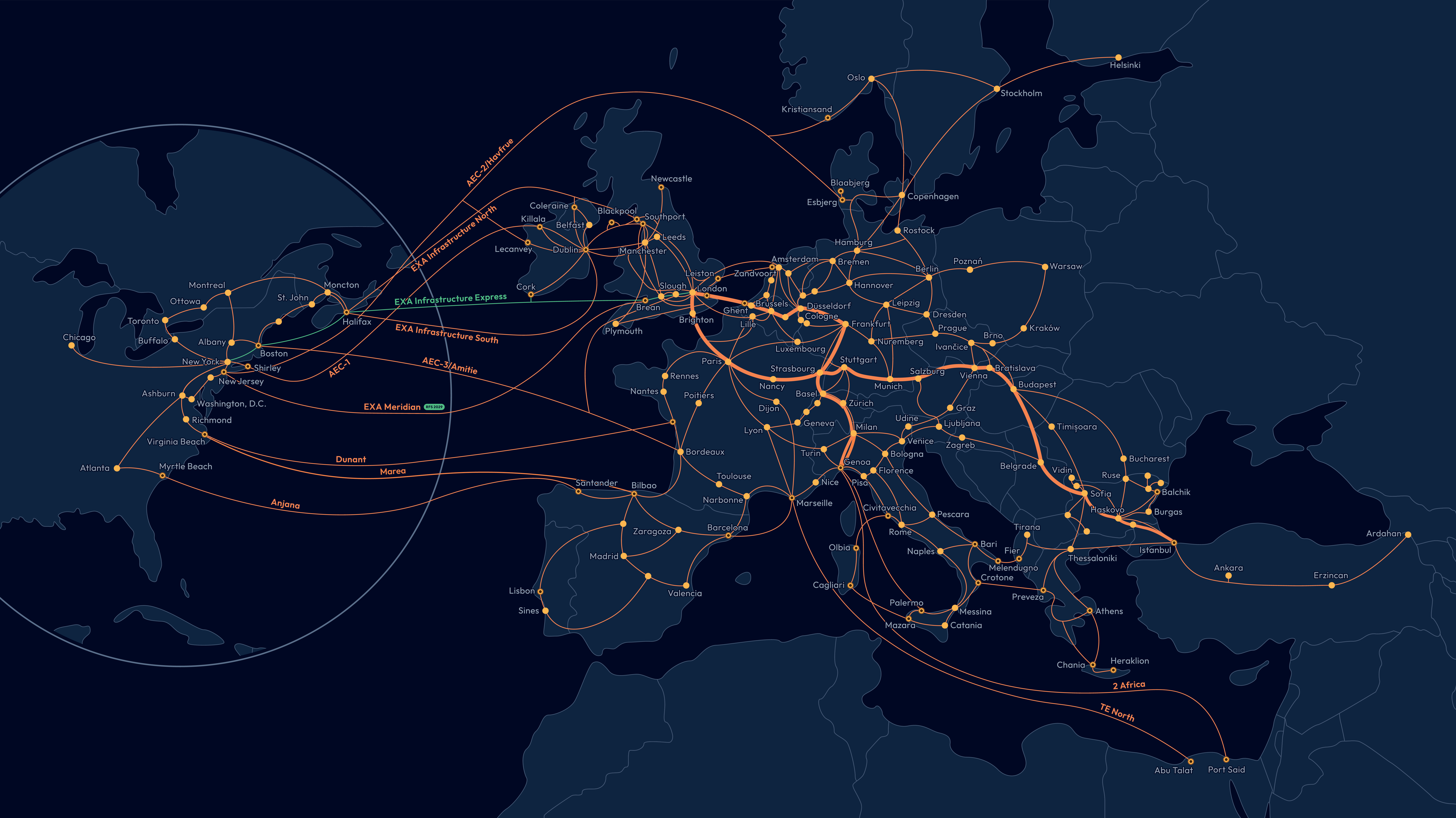
- The team tested the technique on a 5,860 km-long submarine optical fibre link between the UK and Canada, provided by EXA Infrastructure
- Up to 12 sensors were implemented along the cable, and future upgrades will increase this number to 129
- The method could expand global earthquake monitoring from land to the seafloor and could potentially be used for detecting tsunamis
Undersea cables turned into sensor arrays
Teddington, London, UK: 20 May 2022 – Scientists at the National Physical Laboratory (NPL) have successfully demonstrated a disruptive new technique that transforms undersea power and telecom cables into arrays of environmental sensors. The new technique has the potential to revolutionise monitoring of the earth by enabling scientists to acquire for the first time continuous, real-time environmental data from the bottom of seas and oceans. The game-changing results are published in Science Magazine today.
Why the seafloor is mostly unmonitored
Despite the significant expansion of sensing capabilities, seas and oceans today still remain mostly unmonitored. Only a handful of permanent ocean-floor sensors exist globally, as installing and maintaining them is technologically challenging and prohibitively expensive. This leaves a huge gap in geophysical data, limiting our understanding of the Earth’s structure and its dynamic behaviour.
Previous work by NPL and its partners in 2018 showed that submarine cables could be repurposed as sensors for the detection of underwater earthquakes by using ultra-stable interferometric techniques. However, one cable could act only as a single sensor, and measurements were limited only to the integrated changes over the entire length of the cable.
How the new technique works
The new research demonstrates how some cables can be converted into an array of sensors rather than just a single sensor. The NPL-led team, which included researchers from the University of Edinburgh, the British Geological Survey, the Istituto Nazionale di Ricerca Metrologica, and Google, tested the technique on a 5,860 km-long intercontinental submarine optical fibre link between the UK and Canada. The cable used for the project has been provided by EXA Infrastructure, the largest dedicated digital infrastructure platform connecting Europe and North America.
Who took part in the research
- NPL led the team
- University of Edinburgh
- British Geological Survey
- Istituto Nazionale di Ricerca Metrologica
- Google, with the cable provided by EXA Infrastructure
The team showed the detection of earthquakes and ocean signals, such as waves and currents, on individual spans between repeaters spread across the entire transatlantic connection. The optical fibre in each span acted as a sensor.
In this research up to 12 sensors were implemented along the cable. Future upgrades will increase this number to 129. Crucially, the data from these sensors can be recorded, continuously and in real time. The cable-based array of sensors can identify the epicentral area of earthquakes in the same way that land-based seismometers are able to.
What the method could enable
By applying this new method to the existing network of submarine cables, huge areas of the ocean floor, which are currently unmonitored, can potentially be instrumented with thousands of permanent real-time environmental sensors. It would effectively transform underwater telecoms infrastructure into a giant array of geophysical sensors.
Integrating this innovative cable-based approach with current seismometer-based networks means the method has the potential to substantially expand the global earthquake monitoring infrastructure from land to the seafloor where only a handful of permanent seismometers are currently installed. The method does not require any change to the underwater infrastructure, providing for the first time an affordable and scalable solution for sea floor monitoring on a global scale.
Due to optical fibre cable’s sensitivity to environmental perturbations, this research also opens up the possibility of monitoring for other natural phenomena - for example, improving our understanding of deep-water flows, including the proposed slowing down of the Gulf Stream due to rising global temperatures. Although not yet demonstrated in this research, the method could potentially also be used to monitor long-term seafloor temperature changes connected to climate change.
Furthermore, the research results provide evidence that the method could potentially be used for detecting tsunamis. Enabling the real-time detection of tsunami-inducing earthquakes closer to their off-shore epicentre could save lives by giving national government agencies crucial extra time to warn of an impending incident.
The research team now plans to test the method on multiple submarine cables, including those in more seismically active areas such as the Pacific Ocean where there are more opportunities to properly assess the ability to accurately detect tsunamis.
The full results from this research can be viewed in the team’s paper here https://www.science.org/doi/10.1126/science.abo1939
What the researchers said
Giuseppe Marra, Principal Research Scientist, NPL said, “This new technique opens a new era for Earth monitoring by providing for the first time a feasible solution to the lack of environmental data from the bottom of seas and oceans. We can now harness existing underwater cables as a valuable tool for Earth sciences and beyond. This breakthrough is a perfect example of how ultra-stable optical frequency metrology can transition from the laboratory to improve our understanding of the world and also deliver tangible benefits to society.”
Valey Kamalov, Principal Engineer, Google Global Networking, Optica Foundation Board of Directors said: "Synergy of optics, geophysics, and submarine cable engineering produced extraordinary results applicable to climate change and public safety. It is an excellent example of public-private partnership with clear societal benefits. I encourage the cable industry to watch the technology's progress."
Ciaran Delaney, Chief Operating officer, EXA Infrastructure said, “Earth is being observed as never before; we are excited by the potential of NPL’s breakthrough sensing capabilities using our subsea cables and by the possibility of enabling such scientific advancements”.
Professor Andrew Curtis, Chair of Mathematical Geoscience, School of GeoSciences, University of Edinburgh, said, "Oceans cover two-thirds of planet Earth, yet we know relatively little about deep oceanic processes such as currents and water-borne sounds, and about processes that occur in the Earth's crust beneath the deep oceans such as volcanism, landslides and small earthquakes.
“This new type of sensor array extends across the Atlantic Ocean between the UK and Canada, and records earthquakes, storms and deep ocean tides, all remotely from the on-shore landing station. We can now create a new, global network of sub-oceanic sensors, providing a unique insight into planet Earth."
Brian Baptie, Head of the Earth Seismology team, British Geological Survey, said, "This research has the potential to transform our ability to make measurements over vast areas of Earth’s surface where it is very difficult to use conventional sensing technologies. It creates an amazing opportunity to observe earthquakes in the middle of oceans at close range as well as the tantalising possibility of measuring other natural phenomena like submarine volcanic eruptions and tsunami in future. It is also a great example of how scientists from completely different fields can work together."
Davide Calonico, Researcher, INRiM, comments: “Our seminal work in 2018 turned coherent laser interferometry from a laboratory technique to a powerful tool for geophysical sensing, and today a new step forward confirms it can be extended to thousands of kilometres, reaching even the most remote areas of our planet. This collaboration also succeeded in demonstrating how optical communication networks can be employed in a smart way, for advancing science and society."
-ends-
About NPL
NPL is the UK’s National Metrology Institute, providing the measurement capability that underpins the UK's prosperity and quality of life.
From new antibiotics to tackle resistance and more effective cancer treatments, to secure quantum communications and superfast 5G, technological advances must be built on a foundation of reliable measurement to succeed. Building on over a century’s worth of expertise, our science, engineering and technology provides this foundation. We save lives, protect the environment and enable citizens to feel safe and secure, as well as support international trade and commercial innovation. As a national laboratory, our advice is always impartial and independent, meaning consumers, investors, policymakers and entrepreneurs can always rely on the work we do. Based in Teddington, south-west London, NPL employs over 600 scientists. NPL also has regional bases across the UK, including at the University of Surrey, the University of Strathclyde, the University of Cambridge and the University of Huddersfield's 3M Buckley Innovation Centre.
For more information visit: www.npl.co.uk
Follow us on Twitter: https://twitter.com/NPL
Follow us on Facebook: https://www.facebook.com/npldigital
Follow us on LinkedIn: https://www.linkedin.com/company/national-physical-laboratory
About EXA Infrastructure
Headquartered in London, UK, EXA Infrastructure is the largest dedicated digital infrastructure platform connecting Europe and North America, and owns 112,000 kilometres of fibre network across 32 countries. EXA’s network connects 300 cities and offers 14 Tier 3-equivalent data centres, with sub-sea routes that include three transatlantic cables, one the lowest latency link between Europe and North America. EXA is wholly owned by I Squared Capital.